The Horse Racing Industry Transition Panel recently released "Toward a Sustainable Future – A Draft Plan for Horse Racing in Ontario." Some of the concepts introduced in it are excellent, some good, but some miss the mark completely.
Matching wagering commissions with public funds (well actually OLG funds). Great idea.
Here is how I would tweak it (some of the following is exactly what is recommended). Thoroughbreds share the commissions (after expenses) of all wagers made on thoroughbred races, both on Ontario product and non Ontario product. This goes for Standardbreds as well. For example, net commissions that are made on Meadowlands bets end up in the harness racing pool. Quarter horse racing needs to be dealt with though, there is no way they can survive using just this formula, and that is why I think Los Alamitos needs to be designated as a quarter horse track and of course any other specific quarter horse meets. Any wagers on quarter horse races at tracks like Turf Paradise should also go into the quarter horse pot as well.
The total commission monies should go to purses (most, if not all the matched funds will need to go towards track operations and marketing). The idea to divide it up amongst tracks based on percentage Ontario handle for each breed type is good, but based on total all source handle is even better. Large handle is contagious and can lead to exponential growth. Horseplayers like to bet on a superfecta that has a pool of $20,000 much more than they do a $5,000 pool or less. All source handle gives tracks incentive to market to the US and cut deals like the Meadowlands recently made.
Racetracks should have incentive to attract live handle and keep simulcasts going year round and also open up the possibility of giving out betting rewards as well to live customers. That is why, racetracks should be allowed to receive all non Ontario racing handle commissions for purses on all bets made at their establishment (this will help Ajax as well). However, they also should be mandated to have any live Ontario track(s) on their TV monitors, just as HPITV needs to be mandated to show all live Ontario race cards that can be wagered on through a betting account.
The marketing budget could include giving out free program past performances at live racetracks for all Ontario tracks that race on a particular day.
The idea of being cognizant of schedules is a must and that is addressed in the draft, which means it is unlikely more than 3 Ontario tracks will run conflicting schedules. It would be well advised that only up to two Ontario cards should overlapping with each other at any time.
Rebating and/or lower takeout should be encouraged. Rebates need to come out of the commission pools, but it is almost guaranteed that not only will the commissions be eventually regained, but because gamblers will have more bang for their buck, they will most likely devote more funds to the game.
The report misses the mark badly on two fronts. One is suggesting HIPS should be directed more towards excellence. The other is the reports neglect when it comes to the absolute necessity of a B race thoroughbred track.
The Panel wants to reward quality when it comes to Ontario breds. Quality Shmality. Horse racing in Ontario has had over 14 years of inflated purses. Not just on the Ontario sired side, but also when it came to open races. With slots for racing programs now at Aqueduct and Ohio, quality will drop off regardless. It isn't a bad thing either, because bettors don't give a hoot when it comes to 5 horse allowance races whether the purse is $40,000 or $90,000.
Here is the thing. Horseplayers wager for different reasons. The biggest being, they like the action. The action is what triggers their fun or satisfaction. This is why takeout is important. The lower the takeout, the more fun/satisfaction the Horseplayer receives. Another big reason for playing, is the opportunity of a big score. This is why pool size matters, and why, magically it seems, races with the biggest field sizes attract the largest handles.
Sure, there is attraction to big races like the Queen's Plate, but those days and races are rare. Still, a 6 horse Queen's Plate would attract very little handle compared to a 12 horse race.
The point here is that an Ontario sired race with a big field will always outhandle a short field open allowance race.
Here is something for the Panel to digest:
On Canada Day, at Woodbine, there was a $150,000 Stake race with a quality field of 7 betting interests, so much quality a new track record was set. There was also an Ontario sired filly maiden race with a purse of $50,000 that attracted 13 betting interests.
Which race attracted more betting?
Answer, the Ontario sired maiden race by over 40%.
If you tell Ontario breeders that they need to breed only high caliber horses that have to compete head to head with Kentucky breds, they will simply stop breeding. When that happens, you lose direct employment, potential owners and new partnerships, and jobs that depend on horse racing.
Field size matters a lot more than quality does. More quality won't grow thoroughbred racing in Ontario. Larger field size will, and taking away incentives for Ontario breeders by telling them to only breed champions, will reduce breeders, owners, and horses...which will lead to smaller field sizes in the long run, and less betting.
I understand the intentions of the panel, but sometimes good intentions have bad consequences due to flawed insight and foresight. An example of this is when the decision was made to stop giving Ontario breds full purses if they were claimed in a race. The idea was that owners could wait to claim the one with potential instead of taking a shot and buying them as yearlings. Did this cause higher yearling prices? No. What it did was take some Ontario owners out of the game or reduce their stables, and it made Ontario breds less valuable to seek out. All things being equal, would you rather claim a Kentucky bred or Ontario bred if they are both going to run for the same rewards next time out? To increase the value of Ontario breds you need to increase the value of the lowest tier Ontario breds and go from there. That is why Ontario bred claiming races are a good idea. I notice Woodbine has started up with a condition that has the potential to increase Ontario bred thoroughbreds (20k claiming, NW3 or Ontario sired).
I've written about increasing field size before too. If tracks are serious about increasing wagering, my idea of having 7 horse or less betting interests running for 70% of a scaled purse (increasing purse amounts by 15% for each additional betting interest that starts in a race), should be implemented.
I recently did a blog piece on how to increase handle at Harness Racing Tracks. I had a Twitter conversation with Anthony MacDonald, who didn't really like my idea to penalize good horses with post positions, but I stand by my post. Harness racing needs to stop catering to horsemen so much if they want a chance to succeed. I think MacDonald is at least pointed in the right direction.
The Need For A Thoroughbred B Track 101
- The cost of living in Greater Toronto causes thoroughbred ownership to be much higher than it is in a rural town (Day Pay is $80+ compared to $50-$60 at Fort Erie).
- The backstretch at Woodbine doesn't have enough stalls to house B horses during the summer months at this time.
- Thoroughbreds mostly need to train at a racetrack to remain competitive.
- Not all horses take a liking to the polytrack.
- Horses also go out of form in cycles or become non competitive against A horses. When this happens, an owner needs an out in the same jurisdiction and the option to pay lower day pay costs is a must.
- Owners are like gamblers in that they like the action. And most Ontario owners don't want that action to take place where they can't possibly attend (ie the States).
- If an owner's only options for a non competitive horse are to either sell for next to nothing, or ship out of province to race, owners and partnerships will dry up.
- The overwhelming majority of horses running at Fort Erie are owned by Ontario residents.
- If you end up with less owners, you end up with less horses. Eventually, pool size will shrink and betting will decrease in a big way. I'm kind of tired of 5 horse races where the top two or three outfits race against each other for purses that aren't close to being covered by handle.
Fort Erie should be able to survive under the new format/split....barely, until new betting products possibly come out.
Fort Erie should also be awarded gaming zone status once more, in case new products come out, like Instant Racing. I still don't understand how Fort Erie has Bingo Halls at a time when the OLG took away its gaming zone status.
Ideally, Nordic gets bought out. But who would buy a losing business at an inflated price? The only value that piece of land has is as a racetrack. Take it away, and real estate in Fort Erie drops as horsemen sell their homes,and businesses that depend on horsemen when it comes to their bottom line (whether it is hay sellers or Tim Hortons Donut shops) will start going under as well. This will make the value of Fort Erie's racetrack land close to worth nada.
Ideally, the government comes in and buys the track, and then gives it to the proposed OLR or Woodbine to manage. It saves the government giving Nordic payments each year for "rent." But many think that Fort Erie needs to shut down for a year or two so that Nordic finally realistically prices the track. That shutdown though could kill off breeding and kill jobs in the interim.
Finally, a think out of the box idea. The Ontario government states that they are trying to help horse racing (after nearly destroying it), they also emphasize that the industry needs to attract more betting and more customers, especially those who wager on Ontario product. How about an Ontario Tax Credit. $500 for those who wager $10,000 or more on Ontario races, and $1,000 for those who wager $20,000 or more on Ontario races.


13 June 2013
Two Ideas For Harness Racing To Attract Thoroughbred Gamblers
There has been a lot written lately by the harness racing crowd regarding what they need to do to grow their customer base. I'm a hardcore thoroughbred guy, but I've dabbled into the harness racing side of gambling at various times in my life as well. I just couldn't win consistently enough, and the few big payoffs that were attainable, eluded me. I think my biggest hit I ever had was a $3,000 tri one time. I've had many 3k+ hits on the thoroughbred side as my handicapping angles tends to seek big hits outs. This is probably the biggest reason I've pretty much focused only on thoroughbred handicapping.
The USTA Strategic Wagering initiative has opened me up to dabbling a bit on the jugheads for two reasons. One is that the races are part of a guaranteed pool, which means the individual races will tend to attract higher handle and the second reason is because of the free past performances with track variant adjusted speed numbers. I believe TrackMaster has put in some good effort coming up with speed figs.
Still, I have a problem taking harness racing seriously because if the best looking horse gets the 1-3 post position, you almost have to hope it breaks for it not to hit the board at a sub 3/4 mile track. This means that in order to get a well deserved score, you need to hope for an accident.
So here are the two ideas. First, they need to increase the average mutuel payoffs. Solution? The horses with the top two finishes at today's class or better get to draw for the worst post positions. If three horses finished first last time (and none are moving up), they all get in the draw. Also added to the draw, the horse with the best raw time last race (of course, adjusting for different track sizes if the horse is shipping in). This would penalize a horse either coming from a superior race with perhaps a not so great finishing position who is dropping down, or a superior horse on the improve, moving up.
This will completely change the nature of game. The best horses in the race will have the 6,7, and 8 post almost all time. There will be very few 3-5 shots and higher payoffs will become the norm.
The second idea. Free past performances with track adjusted speed figures.
Canadian harness race tracks have free past performances at their websites. Problem is that they just have raw times. Maybe back in the 70's raw times would have created crossover, because the that is all the thoroughbred crowd had to go on unless they made their own speed figs. But almost all of today's thoroughbred gambler relies on speed figs, pace figs and/or trainer angles. The raw time crowd is playing slot machines.
When I was younger, I often heard that speed doesn't matter in harness as much as thoroughbreds. Well, that was when harness horses were 5 seconds slower than they are today. Now that they, like thoroughbreds are running at or near their possible highest speed, track variant matters. I'm not talking the -2 or -4 bs harness tracks put up when it rained, or whatever they did. I mean a real variant adjusted speed fig that is based on averages of final times during the course of a card using the class of each winner and then dividing by the amount of ratable races. And since all the races are a mile, it isn't as complicated or prone to error as it is on the thoroughbred side.
A free harness program with only raw times is like Shakespeare to me. I'll read a couple of lines, scratch my head, and put the book back in the bookshelf.
The industry should just pay an info provider like TrackMaster for their past performances. Put them out there for anyone and everyone who wants to look at them. I think a decent handle increase will be inevitable, but if the harness industry wants handle to really improve, they need to incorporate both of my ideas.
I also believe free past performances would increase thoroughbred handle and attract new business, but this blog post was about crossover, so we'll leave it like that.
Related Reading: Why Don't Thoroughbred Fans Embrace Harness Racing & Can Anything Be Done About It? Part One Part Two
8 June 2013
"O" My, I Almost Forgot To Make My Belmont Stakes Picks
I want to first give you today's most useless fact. If Overanalyze wins, it would mean that this year's Triple Crown was won by three separate horses with names that begin with the letter "O." I did some real quick research (by real quick, I mean, I could have missed something because I was barely awake at the time) and found that there have been four Kentucky Derby winners whose name started with "O": Orb, Omaha (who won the Triple Crown in 1935), Omar Kayyam (1917) and Old Rosebud (1914). When it comes to The Preakness, there has been three: Oxbow, Omaha, and Old England (1902). Finally, The Belmont has produced only two so far: Omaha and One Count (1952). In case you were wondering, yes, President Barack Obama is the only President whose name begins with "O."
So what are the odds that three separate individual horses win the 2013 Triple Crown with names beginning with "0" in a year that also has a President also has a name beginning with "O": Right now, it is around 15-1 (Overanalyze's probable post time odds with takeout taken into consideration). What was the chances 8 years ago? Probably something in the neighborhood of a few billion to one.
Anyway, I'm not going to Overanalyze the Belmont, here are my picks:
Vyjack: I heard his trainer has been cold (maybe he is just nervous being under a microscope), but I do like the odds. Vyjack didn't take to Kentucky slop, but he seems to like NY soup. Hey, the track may dry out by race time, but he likes a fast track too.
Orb: Hated him in the Preakness. But he does look like he has an edge here. Figure wise and recency he rates well. He did win in the slop too, in case you forgot.
Will Take Charge: My gut feeling is that we are going to see the horse who won the Rebel today at a juicy price.
Oxbow: As long as the track is somewhat favorable to early speed or even fair, he should last to be a piece of the pie today.
3 June 2013
Grand River Raceway Gets Serious
Recently, I did a post on the Canadian Track Takeout Landscape. One thing that stood out is the very high track takeout the majority of harness tracks (and Fort Erie on the thoroughbred side) has compared to the rest of the industry, despite years of receiving slots revenues.
I am happy to see that at least one track has made a huge step in the right direction. Grand River Raceway, which begins their 2013 season tonight at 7:05 PM, has drastically reduced most of their track takeouts, and especially the ones that produce the most churn:
Win/Place/Show takeout rate reduced from 21.90% to 16.95%
Exactor takeout rate reduced from 21.90% to 20.50%
Daily Double takeout rate reduced from 21.90% to 15%
Pick 4 takeout rate reduced from 24.90% to 15%
These takeout reductions will help in two ways. One is to put Grand River Raceway on the radar with Horseplayers across North America. The second, and probably most important, is cultivating their live customer base. Gambling is 90%+ psychological, and even if gamblers are cognizant about rates (most aren't), they get pleasure when they bet, and the longer they can stay in action, the more fun they have. This is the main reason that slots, being so unbeatable, is so popular.
Begging players to show up at a live venue to support a track might short term, but if the fans don't get a proper gambling fix, the will stop coming. Racetracks need to realize that the entertainment they provide is gambling, and all gamblers/consumers are price sensitive, and now more than ever with the end of the slots revenue gravy train.
Reducing takeout in today's environment doesn't have to produce sensational results because a high percentage of wagers come from online bettors who are playing many tracks at once. Many of these players though are price sensitive and are likely to consider Grand River now. Bill Finley touches on the reality of takeout reductions pertaining the Grand River Raceway announcement. Finley did leave out the newbie cultivation angle, which I believe is very substantial.
On-track players, especially the casual ones who have the potential to become regulars and even large bettors in the future, tend to wager most of their bankroll on the live product, so someone who cashes a wager at Grand River will likely churn the money back on a Grand River bet, and not another track with a higher takeout.
Note to racetracks who think that marketing in ways that don't include price reductions (lower takeout):
Insanity: doing the same thing over and over again and expecting different results.
-Albert Einstein
Also read: PTP's Racing's Price Evolution and Bettors To Get A Better Deal At Grand River Raceway.
Free Past Performances for Grand River Raceway are provided here, usually 24 hours before races begin.
17 May 2013
Orb Will Be A Tremendous Underlay
Orb is great Orb is this and Orb that, c'mon people, the horse won in the goop. I've been handicapping races for a long long time and one of my steadfast rules is to not rate off track races unless it is the only race the horse has in its past performances, and if that is the case, do so with extreme reluctancy. Take away his Kentucky Derby win, and his speed numbers are slightly inferior to more than just one Preakness entrant. I'm not saying he can't win, but he will be a huge underlay, not the biggest underlay of the year, as I've seen many 3-5 shots or less go down the tubes at Aqueduct and Belmont this year, for example, horse that looked like really bad bets going in. Orb could also be like a Zenyatta, the speed figures might not matter, he just gets it done. But I really don't like him tomorrow. Besides the inferior speed figs and the big win in the slop, there is also the fact that he was well prepped off a month plus layoff prior to the Derby, this also makes him a big bounce candidate.
Horses like Orb make the game beatable. Yes, they win some of the time, but because they are so overbet, it means there will be others in the race that will be underbet. Seeking value is the only way to beat the game in the long run, and unless Orb goes off at 7-1 or better, there is no value there.
I got dusted with my Derby picks, but again, this is a long term game and the Derby was just a race. That being stated, I am probably very due when it comes to getting the Preakness close to right. So who do I like? My ratings came up with three horses close to tied.
Mylute, with Rosie Napravnik, could be the one. He had a very good speed figure in the Louisiana Derby, and the 30+ day layoff going into the Derby might have been a negative. In fact, this horse rarely runs twice within a month, but looking his Derby line, I have to figure that coming back within two weeks could mean a peak performance from him. He will most likely need a fair track or more preferably a closer's track, in order to win the race.
The fact that Goldencents is in the race, means either you can totally discount his 49 length loss in the Derby, or that his connections are just plain nuts. I am leaning towards the former. He had a very good number in the Santa Anita Derby, and figures to be very close to the pace in the Preakness. If he is right, I don't think he will be compromised by other early speed in the race, and there isn't much of a difference between 1 mile and an eighth and 1 mile and 3/16th, so distance shouldn't be an issue.
Oxbow is the final horse in my top three. The Preakness distance looks perfect for him, and the expected pace of the race and his post position, makes him a contender. He ran a good race in the Derby, and should be able to time his move much better tomorrow, his past figures are decent, and he should have no problem outrunning his final odds in the Preakness.
A case could be made for almost every horse in the Preakness. If I use Orb, it will be on one superfecta ticket with my top three picks.
ADVERTISEMENTS


CLICK TO OPEN A FREE ACCOUNT AT HORSEPLAYERSBET.COM


Horses like Orb make the game beatable. Yes, they win some of the time, but because they are so overbet, it means there will be others in the race that will be underbet. Seeking value is the only way to beat the game in the long run, and unless Orb goes off at 7-1 or better, there is no value there.
I got dusted with my Derby picks, but again, this is a long term game and the Derby was just a race. That being stated, I am probably very due when it comes to getting the Preakness close to right. So who do I like? My ratings came up with three horses close to tied.
Mylute, with Rosie Napravnik, could be the one. He had a very good speed figure in the Louisiana Derby, and the 30+ day layoff going into the Derby might have been a negative. In fact, this horse rarely runs twice within a month, but looking his Derby line, I have to figure that coming back within two weeks could mean a peak performance from him. He will most likely need a fair track or more preferably a closer's track, in order to win the race.
The fact that Goldencents is in the race, means either you can totally discount his 49 length loss in the Derby, or that his connections are just plain nuts. I am leaning towards the former. He had a very good number in the Santa Anita Derby, and figures to be very close to the pace in the Preakness. If he is right, I don't think he will be compromised by other early speed in the race, and there isn't much of a difference between 1 mile and an eighth and 1 mile and 3/16th, so distance shouldn't be an issue.
Oxbow is the final horse in my top three. The Preakness distance looks perfect for him, and the expected pace of the race and his post position, makes him a contender. He ran a good race in the Derby, and should be able to time his move much better tomorrow, his past figures are decent, and he should have no problem outrunning his final odds in the Preakness.
A case could be made for almost every horse in the Preakness. If I use Orb, it will be on one superfecta ticket with my top three picks.
ADVERTISEMENTS
CLICK TO OPEN A FREE ACCOUNT AT HORSEPLAYERSBET.COM
4 May 2013
Obligatory Kentucky Derby Post
The Kentucky Derby, the most hyped 2 minutes in sports, goes off today, hosted by an organization that doesn't give a rats behind when it comes to growing horse racing. OK enough with the negativitytruth, lets move on to my analysis.
I have to stick to my handicapping guns. I don't like horses who race a mile and a quarter who have been off over 30 days. That line of thinking was much better 30 years ago before trainers started
racing horses like they are in Europe, and before such phenomenal training methods like hyperbaric chambers were used by "clean" trainers. But still, those who raced within 30 days have a distinct advantage over those who haven't.
So I am eliminating these horse from finishing 1-2: Revolutionary, Golden Soul, Mylute, Giant Finish, Lines Of Battle, Itsmyluckyday, Orb (yes, Orb), and Will Take Charge.
Now that I have the race down to 11 contenders, time to eliminate the slower ones, or the ones that appear farther off from a peak race. Those are Overanalyze, Frac Daddy, and Fallen Star.
So now we have eight, and to be honest, on figures, they are inseparable to the point that trip will mean just about everything. That being stated, value is key. That means eliminating Goldencents and Verrazano. Gun to head, I like the latter better, for what it is worth.
I Tweeted that Normandy Invasion will win in a romp, but that was before he ran off with his exercise jockey in the morning, so I've downgraded him to third. I am now leaning heavy on Palace Malice to win the Derby. The distance
doesn't seem to be a problem, and coming off an artificial surface might just give him a huge fitness edge, and he seemed to just be short in his last. I can't say that Pull The Pocket hasn't influenced my decision to rate Vyjack high, but he needs to put the pom poms down because the 19 post might make it very difficult for Vyjack to have the trip needed to win. Oxbow has had three 10 posts in a row and now gets the rail in the Derby. This could mean the shortest trip around the track for jockey Gary Stevens. Java's War, who beat my selection in the Blue Grass maybe peaked a race too soon, and his last to first effort including a terrible start has sucker's bet written all over it, but he just can't be dismissed today, and Charming Kitten just seems to be a fringe contender, but a perfect trip could mean roses just the same. He did show good turn speed in the Blue Grass.
10-20-5-2, that is my four horse box.
Go Palace Malice, but more importantly, it would be nice to see a horse compete for a chance at the Triple Crown in the Belmont this year.
Here is the 2013 Blue Grass Stakes:
26 April 2013
Updated Google Takeout Maps Of North American Racetracks
Thoroughbred Tracks
View Thoroughbred Racetracks in a larger map
Harness Tracks
View Harness Racetracks in a larger map
ADVERTISEMENT
YOUR BEST CHANCE TO BEAT THE PONIES!
 HORSEPLAYERSBET.COM offers Horseplayers industry high Player Reward Bonuses. Start getting bonuses immediately.
SPECIAL BONUS OFFER TO NEW MEMBERS AT HORSEPLAYERSBET.COM
BET $80 GET $40 DEPOSITED INTO YOUR ACCOUNT
Wager at least $80 in total, win or lose, and you will get $40 deposited into your account. You will also start receiving industry high Player Reward Bonuses daily as soon as you start wagering. To earn the $40 Bonus you must wager at least $80 in total within 7 days of making your initial deposit.
CLICK TO OPEN A FREE ACCOUNT
More Reasons?:
* Industry High Player Reward Bonuses added to your account daily
* User friendly betting interface makes wagering easy
* FREE LIVE VIDEOS
* FREE RACE REPLAYS
* Wager Online or by Phone
* Great customer service
* 100% Parimutuel
* Bet cancellation capabilities
* No membership or wagering fees
HORSEPLAYERSBET.COM, "WHERE HORSEPLAYERS COME FIRST." SIGN UP FOR FREE AND SEE WHY HORSEPLAYERSBET.COM IS ONE OF THE FASTEST GROWING ADWS
Player Reward Bonuses could be the difference to you as to whether you win in the long run playing horses, or lose. Sure, you still need skill and luck as well to succeed, at HORSEPLAYERSBET.COM at least you have a fighting chance. And one thing is for sure, your money will last longer because of the PLAYER REWARD BONUSES you receive.
View Thoroughbred Racetracks in a larger map
Harness Tracks
View Harness Racetracks in a larger map
ADVERTISEMENT
YOUR BEST CHANCE TO BEAT THE PONIES!
WATCH UP TO FOUR LIVE RACE FEEDS ON ONE SCREEN
SPECIAL BONUS OFFER TO NEW MEMBERS AT HORSEPLAYERSBET.COM
BET $80 GET $40 DEPOSITED INTO YOUR ACCOUNT
Wager at least $80 in total, win or lose, and you will get $40 deposited into your account. You will also start receiving industry high Player Reward Bonuses daily as soon as you start wagering. To earn the $40 Bonus you must wager at least $80 in total within 7 days of making your initial deposit.
CLICK TO OPEN A FREE ACCOUNT
Horseplayers do not like deposit fees. Horseplayersbet.com understands this and that is why next day deposit fee refunds are offered.
Deposit $100 or greater online or by phone using a credit or debit card and the 4.5% fee will be refunded to your account the next morning.
Deposit and wager at least $120 using a Green Dot MoneyPak and you will receive 4% of your deposit, so even though a Green Dot MoneyPak costs $4.95, if you deposit $200, you will receive a funding fee rebate as well as a bonus totalling $8, if you deposit $500, you'll receive $20. This is on top of Player Reward Bonuses.
More Reasons?:
* Industry High Player Reward Bonuses added to your account daily
* User friendly betting interface makes wagering easy
* FREE LIVE VIDEOS
* FREE RACE REPLAYS
* Wager Online or by Phone
* Great customer service
* 100% Parimutuel
* Bet cancellation capabilities
* No membership or wagering fees
HORSEPLAYERSBET.COM, "WHERE HORSEPLAYERS COME FIRST." SIGN UP FOR FREE AND SEE WHY HORSEPLAYERSBET.COM IS ONE OF THE FASTEST GROWING ADWS
Player Reward Bonuses could be the difference to you as to whether you win in the long run playing horses, or lose. Sure, you still need skill and luck as well to succeed, at HORSEPLAYERSBET.COM at least you have a fighting chance. And one thing is for sure, your money will last longer because of the PLAYER REWARD BONUSES you receive.
14 April 2013
The Canadian Track Takeout Landscape
I want to first say, I love horse racing. To me, nothing beats it when it comes to intellectual gambling. I'd love to see horse racing grow instead of what we see today, which is an industry that paddles against the rapids. Horse racing fails to compete with other forms of gambling like sports betting, poker, and slots which have much lower takeouts (house edges, rakes, whatever you want to call it). And please lets not use the lottery argument, as it is apples to oranges, because when one buys a lottery ticket, they aren't looking for a gambling fix so much as they are buying a dream.
The other argument that I hate to hear is that most people don't know what the takeout is. That was probably very true 10 years ago, and it is partially true today. However, it doesn't matter if players know what the takeout is when they gamble. Gambling for most is probably 90% plus psychological. What I mean by that is that when one gambles continuously there is a scale of satisfaction that determines how long they gamble and what they gamble on. If someone has the idea that they are close to winning or winning, they will play more, if they constantly go broke quickly, their desire to come back diminishes.
Horse racing is plagued with a high learning curve and no real visible long term winners (though some exist but that is sort of a secret). Why should someone learn to handicap horses if there is the idea the game cannot be beaten long term? Sure, slots has no long term winners (except possibly for the odd huge jackpot winners), but it has no learning curve and because of the low rake (4-8%) there are enough wins in an hour for most gamblers to give them the impression they are close to winning, and frequent cashes satisfy their brains the same way inhaling crack does for a drug addict. Editor's note: If I had my way I would limit slots and roulette (not expand them) because the games are unbeatable in the long run no matter the level of expertise one has, and especially when it comes to slots, the game intentionally prays on trying to attract the addict in you.
Horse racing needs to give players more satisfaction, and that comes with higher churn, which means lower takeout. A lower takeout means that some visible winners may be able to show their faces, and that will draw more players just like it did with poker.
In Canada, especially Ontario, it seems the opposite approach has been taken. Ontario racetracks and horsemen had slot revenues subsidizing their operations and purses for the past 14 years. Did horse racing grow? No way. And taxes can't be used as an excuse either. Only 1.3% of what is wagered go for provincial and federal taxes (the federal portion, 0.8%, goes towards drug control, photo-finish, video patrol and audit services). Check out the chart below. It looks like most track didn't even try to compete or grow. For comparison purposes, I added Keeneland (HANA's number one rated thoroughbred track), and the Meadowlands, which would most likely be the number one harness track if HANA did harness ratings:
Ontario racetracks are now faced with the reality that they need to nurture and grow their customer base. Fans are good, but Ontario racetracks need bettors. Since, for the most part, very little handle comes from live wagering, it is time for Ontario tracks to do a massive overhaul when it comes to takeout reductions, in order to compete with other tracks on ADW and simulcast menus but also to grow their own local customer base. Lower takeouts keep seats in the crowd longer, and the more often the regulars go, the more likely they are to introduce newbies.
On a bright note, Woodbine seems to be coming along. They recently announced that they are dropping the takeout on win bets to 14.95%, which is the lowest win takeout on the North American continent. A year or so ago, they dropped takeout on triactors to 25% from 28.3%. These are steps in the right direction, and I really like the fact that Woodbine, by lowering takeout on win bets, is recognizing the power of churn. Lowering exotics like Pick 4's or Pick 5's are not recognizing churn but an attempt to compete with other tracks, which is important, but these type of initiatives do little or nothing to gain more business for the industry.

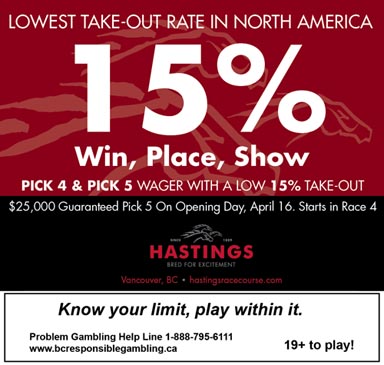
When it comes to Canadian tracks, kudos go out to Hastings. If they can just get their field sizes up, I believe we would see handle sky rocket. Yeah, field size is very important too.

The one thing I don't get is why didn't Woodbine drop place and show, which have even higher churn than win. Sort of reminds me of this Seinfeld scene:
How to get field size up for thoroughbreds? Take the normal purse structure, give out only 70% for 6 horse betting interest fields or less, 80% for 7 horse fields, 90% for 8 horse fields, 100% for 9 horse fields, and add 10% per betting interest over 9 horse fields. A field of 12 would be going for 130% the base purse. It only makes sense that if a horse beats 12 it more of an accomplishment than beating 5, but what really makes sense is that field size is probably the biggest factor when it comes to the relative amount bet in total on a specific race. Now just to get the Horsemen on side for this one:)
Just remember, lower takeout is the Horseplayer's friend, and what is good for the Horseplayer is good for the growth of the industry.
The other argument that I hate to hear is that most people don't know what the takeout is. That was probably very true 10 years ago, and it is partially true today. However, it doesn't matter if players know what the takeout is when they gamble. Gambling for most is probably 90% plus psychological. What I mean by that is that when one gambles continuously there is a scale of satisfaction that determines how long they gamble and what they gamble on. If someone has the idea that they are close to winning or winning, they will play more, if they constantly go broke quickly, their desire to come back diminishes.
Horse racing is plagued with a high learning curve and no real visible long term winners (though some exist but that is sort of a secret). Why should someone learn to handicap horses if there is the idea the game cannot be beaten long term? Sure, slots has no long term winners (except possibly for the odd huge jackpot winners), but it has no learning curve and because of the low rake (4-8%) there are enough wins in an hour for most gamblers to give them the impression they are close to winning, and frequent cashes satisfy their brains the same way inhaling crack does for a drug addict. Editor's note: If I had my way I would limit slots and roulette (not expand them) because the games are unbeatable in the long run no matter the level of expertise one has, and especially when it comes to slots, the game intentionally prays on trying to attract the addict in you.
Horse racing needs to give players more satisfaction, and that comes with higher churn, which means lower takeout. A lower takeout means that some visible winners may be able to show their faces, and that will draw more players just like it did with poker.
In Canada, especially Ontario, it seems the opposite approach has been taken. Ontario racetracks and horsemen had slot revenues subsidizing their operations and purses for the past 14 years. Did horse racing grow? No way. And taxes can't be used as an excuse either. Only 1.3% of what is wagered go for provincial and federal taxes (the federal portion, 0.8%, goes towards drug control, photo-finish, video patrol and audit services). Check out the chart below. It looks like most track didn't even try to compete or grow. For comparison purposes, I added Keeneland (HANA's number one rated thoroughbred track), and the Meadowlands, which would most likely be the number one harness track if HANA did harness ratings:
| Racetrack | WPS | Ex/DD | Tri/Sup | P3/P4 |
|---|---|---|---|---|
| Woodbine TB | 14.95/16.95 | 20.5/20.5 | 25.0/26.3 | 26.3/25.0 |
| Woodbine/Mohawk H | 16.95 | 20.5/20.5 | 27.0/26.3 | 26.3/25.0 |
| Hastings | 15.00 | 21.8/15.0 | 27.3/26.3 | 15.0/15.0 |
| Fraser Downs | 15.00 | 21.3/21.3 | 26.8/26.3 | 22.3/15.0 |
| Assiniboia Downs | 19.00 | 26.0/26.0 | 29.0/29.0 | 29.0/15.0 |
| Alberta Downs | 15.80 | 24.8/24.8 | 24.8/24.8 | 24.8/24.8 |
| Fort Erie | 16.95 | 26.2/26.2 | 28.2/26.2 | 26.2/26.2 |
| Ajax Downs | 24.60 | 24.6/24.6 | 26.6/24.6 | N.A./N.A |
| Western Fair | 21.40 | 26.3/26.3 | 28.3/26.3 | 26.3/15.0 |
| Rideau Carleton | 24.05 | 24.0/24.0 | 27.2/24.0 | 24.0/24.0 |
| Kawartha Downs | 21.30 | 21.3/21.3 | 23.3/24.3 | 24.6/24.6 |
| Flamboro Downs | 24.70 | 24.7/24.7 | 26.7/24.7 | 24.7/24.7 |
| Georgian Downs | 24.70 | 24.7/24.7 | 26.7/24.7 | 24.7/24.7 |
| Grand River | 24.00 | 24.9/24.9 | 26.9/24.9 | 24.9/24.9 |
| Keeneland | 16.00 | 19.0/19.0 | 19.0/19.0 | 19.0/19.0 |
| Meadowlands | 17.00 | 19.0/19.0 | 25.0/20.0 | 15.0/15.0 |
Ontario racetracks are now faced with the reality that they need to nurture and grow their customer base. Fans are good, but Ontario racetracks need bettors. Since, for the most part, very little handle comes from live wagering, it is time for Ontario tracks to do a massive overhaul when it comes to takeout reductions, in order to compete with other tracks on ADW and simulcast menus but also to grow their own local customer base. Lower takeouts keep seats in the crowd longer, and the more often the regulars go, the more likely they are to introduce newbies.
On a bright note, Woodbine seems to be coming along. They recently announced that they are dropping the takeout on win bets to 14.95%, which is the lowest win takeout on the North American continent. A year or so ago, they dropped takeout on triactors to 25% from 28.3%. These are steps in the right direction, and I really like the fact that Woodbine, by lowering takeout on win bets, is recognizing the power of churn. Lowering exotics like Pick 4's or Pick 5's are not recognizing churn but an attempt to compete with other tracks, which is important, but these type of initiatives do little or nothing to gain more business for the industry.

When it comes to Canadian tracks, kudos go out to Hastings. If they can just get their field sizes up, I believe we would see handle sky rocket. Yeah, field size is very important too.
The one thing I don't get is why didn't Woodbine drop place and show, which have even higher churn than win. Sort of reminds me of this Seinfeld scene:
How to get field size up for thoroughbreds? Take the normal purse structure, give out only 70% for 6 horse betting interest fields or less, 80% for 7 horse fields, 90% for 8 horse fields, 100% for 9 horse fields, and add 10% per betting interest over 9 horse fields. A field of 12 would be going for 130% the base purse. It only makes sense that if a horse beats 12 it more of an accomplishment than beating 5, but what really makes sense is that field size is probably the biggest factor when it comes to the relative amount bet in total on a specific race. Now just to get the Horsemen on side for this one:)
Just remember, lower takeout is the Horseplayer's friend, and what is good for the Horseplayer is good for the growth of the industry.
1 April 2013
Wynne Announces Reinstatement Of SARP
At 11:58 PM last night, Ontario Premier Kathleen Wynne called an impromptu press conference at her home porch. Dressed in pink bunny pajamas, complete with floppy bunny ears, Wynne announced that the Slots At Racetrack Program has been reinstated at all Ontario racetracks that are willing to accept a new split. Asked what the new split is, Wynne said it was not something she can discuss at this time, referring to the Ontario Liberal Party main platform: "Keep Ontarians in the dark as much as possible." She added, "we might have a conversation about the splits in the future, possibly sometime before 2017."
Upon hearing the news, the OLG released chair Paul Godfrey. OLG President and CEO Rod Phillips stated that Godfrey was pissing away money marketing dollars faster than a slots addict. Phillips also went on the record saying he has been a "little" deceitful when it comes to the OLG Modernization plans and the creation of more problem gamblers, "although only 2-3% of Ontarians are problem gamblers, they account for close to 50% of the slots revenue for the OLG."
Don't feel sorry for Godfrey though, he quickly applied for and got a job with organ grinder Guiseppe D'Angelo. D'Angelo, who works the corner of Dundas and Yonge was looking for a replacement for his recently retired monkey Gonzo. D'Angelo said that "Godfrey is perfect for the job as he is a natural when it comes to getting suckers to part with money, and the bright side is that I don't foresee myself having to scoop up after him either."
Happy April Fool's Day!
26 March 2013
Countdown To The End Of SARP: One Final Proposal
What a colossal mess hit and run artists Dwight Duncan and Dalton McGuinty created by mandating the end to the Slots At Racetrack Program, using false assumptions, without doing their homework first. With only 6 days until the end of SARP, the Ontario horse racing industry is still in limbo regarding race dates and purse structure and even location, when it comes to the future of the majority of racetracks. Never mind time is running out on another breeding season as well.
It has become evident that even the Transition Panel has bitten off more than they can chew, having only landed racing agreements with not-for-profit tracks. They have been trying to broker deals since December, but hit a major speed bump.
As I understand it, based on what has been put out there in the media and interviews, for-profit tracks have all signed deals with the OLG when it comes to renting out the slots facilities, however, if they choose to get a racing subsidy, rent counts towards their revenues, therefore, in most cases, if they don't race, they make money from rent, but if they race, the best they can do is break even. No matter how much a racetrack owner may love racing, if you are a businessman, you pretty much have no choice but to take the rent money only. Even if there is a possible rainbow at the end of all this junk, a track can always race again in the future if there are profits that can be made from racing.
Can the government justify giving a for profit-track a profit using tax dollars? That is question that we will see answered in the next few days....maybe.
I don't understand how the brakes weren't applied on the end of SARP. The lie by the quitter Dwight Duncan, that there were only 5,000 people in the industry was enough evidence for the government to back down on the decision until further due diligence was done. And then when OMAFRA came up with their conclusions that a major subsidy would be required to keep horse racing on life support, considering all the potential lost jobs, a capable government would have just adjusted the SARP program. But the inept, larcenous McGuinty government was still calling the shots back then.
And now, we are seeing major resistance when it comes to putting a new casino just about anywhere. What this really is saying is that will of the Ontario people are OK with casinos at tracks, in other words, tracks are perfect business partners when it comes to OLG slots, and they should be treated as business partners.
Is there time for a solution? I'm not sure. With the OLG already accepting RFP's for Gaming Zone operators to step in and replace many of the overpaid overcompensated OLG workers, I'm not sure that if a new government was elected today, that they can stop it. But then again, I'm not a contract lawyer.
THE REALISTIC SOLUTION
I've had plenty of time to think about solutions. I don't think giving a subsidy from tax dollars is acceptable at all, nor does it address the future beyond two or three years, as well as there is no incentive for for-profit tracks to continue.
What would I do if I was Premier Wynne?
I would extend the SARP program for 4 years, giving ample time to integrate a possible horse racing lottery, sports betting, Instant Racing, etc. as new sources of revenues so that horse racing can stand on its own. It is my belief that slots are dying a slow death anyway, and racing needs to market horse racing as a competitive gambling game.
I would change the SARP program to 7% for horsemen and 7% for tracks (this saves face sort of). The reality is that at least a good 20% of the industry is gone at this time anyway thanks to the past year's uncertainty.
I would mandate that the entire horsemen's share of slots goes towards Ontario bred races and breeder incentives. This eliminates the $30 million government subsidy, as well as the necessity of the extra 2% the TIP program receives from wagering (which inhibits tracks from experimenting with lower track takeouts). Too much of slots money went to foreign players. Nothing wrong with reciprocation, but it was way too much and took away from Ontario breeders and owners and trainers. Betting revenues can be used to fund open races very effectively.
I would mandate that of the 7% tracks receive, that 33% of it is used towards local marketing and province wide marketing and developing. The balance is to be used for racing operations and some of it will be profit (for for-profit tracks).
I would split racing gross revenues for live racing 55%-45% for the horsemen-racetracks, the same split for home market (simulcast and exported) wagers based but using net revenues instead. I would also add that if a track decides to rebate their home market customers, that 45% of the rebate is deducted from the horsemen share as this incentivizes the tracks to do this which will be great for growing the customer base.
I would mandate that track takeout for Ontario horse racing can not exceed 16% for WPS, 19% for Doubles and Exactors, and 22% for all other wagers (this includes the 1.3% the government receives). This will allow Ontario tracks to compete with all North American tracks and handle and customer base is sure to grow. Even Ohio has a 22% cap on takeout.
Allow tracks to be able to match offers from outside operators in order to run their own casinos. If they can run pari-mutuel wagering, they should be able to handle slots and table games too.
Finally, I would offer slots back to Windsor, Sarnia, and Fort Erie. Taking slots away from these tracks didn't help the numbers at the stand alone casinos. In fact, Windsor casino just announced major layoffs today. If it means that under the 7%-7% proposal, along with slots, that Fort Erie can only race 40 days, so be it. If everything I've put out here is done, horse racing will grow, and Fort Erie dates will eventually grow too.
Update: Wynne just announced that there will be racing at for-profit tracks Fort Erie, Flamboro Downs and Georgian Downs.
9 March 2013
Ontario Horse Racing: It Is Transition Time
Horse racing in Ontario is still in the Wild West despite yesterday's announcement by Temporary Premier Kathleen Wynne who stated she "wants" to see horse racing to be part of the OLG's Modernization Plan. The good thing is that this is a definite policy shift by the beleaguered (very well deserving) Liberal government, but when you consider that the OLG is strongly considering privatizing everything (something the PCs, the number one opposition party in Ontario, also would like to see) and the fact that the Liberals may not be in command a year from now, if horse racing doesn't come together extremely quickly get the ball rolling with specific signed deals, what Wynne stated yesterday might only be nothing more than words of appeasement.
Horse racing in Ontario is good to go for the next 3 years (at approximately 75% of what it was last year), running on monies generated from betting and an actual government subsidy that will mostly be used to pay for racetrack expenses other than purses. Since tracks don't charge admission (if they did right now, no one would go), don't make much off concessions, and other than a handful of Woodbine races, the don't receive any corporate ad monies, their only source of income is through betting, now that slot revenues are no more.
One question of many I have is that Wynne stated racetracks have three year deals with the government regarding subsidies, yet Woodbine stated they have a two year deal. Which is it?
The biggest question right now for Ontario horse racing to immediately deal with is who is going to represent it when it comes to selecting and implementing new revenue streaming ideas that will definitely need to be in place two or three years from now in order to ensure that horse racing remains viable. Horsemen groups historically in Ontario have had a huge sense of entitlement, and even with the dose of reality that has happened over the past year, I have read many recent comments by horsemen who basically state that nothing other than reinstatement of the SARP would be acceptable. They are definitely not customer driven, and horse racing's biggest problem right now is that they don't have nearly enough customers. Racetracks are supposed to be customer driven, but because of slots revenues, customers were placed at the back of the bus. So who is going to lead horse racing into the future, and can there be a leader with all the childish infighting that happens? Whoever it is will definitely need to start understanding the gambler's psyche, if horse racing is survive and potentially grow.
Something I do find a bit troubling is that since the SARP got its walking papers from Ontario racetracks, I have yet to see anything substantial from any Ontario track that would make me want to gamble on horses more, with the exception of HPI allowing some fractional wagers to coincide (almost) with some US tracks, but that was something they were working on prior to the end of SARP. I realize that the whole industry has been suffering from deer in the headlights syndrome for a year now, but there has been no takeout reductions the past 365 days, and comparatively, especially harness B tracks, takeout rates compared to US tracks are sky high. The biggest complaint I hear about from friends is not getting paid track odds on many US exotics. Smaller bettors may not care so much about this, but the bigger bettors do, and all this practice does is chase them away, and racing like many businesses runs by the 80-20 rule where 20% of the customers do 80% of the betting.
Ontario horse racing's future is now dependent on having more customers. The problem horse racing has is that it has too high a learning curve for a game that is perceived as unbeatable (thanks to high takeout rates). Slots is a no-brain required type of gamble that gives the player the illusion of winning, even when they are not, and even though slots is not beatable ever in the long run, it awakens the same parts of the brain as crack does for crack addicts. I find it sort of disgusting the Ontario government is actually looking to expand slots to where there are more people and especially on the internet, but I'll save most of my thoughts for a future post. Poker found success because it is perceived that if you are good enough you can actually make a living as a poker player, which means that there is a perceived chance that even a casual player can make some money long term. The learning curve is nowhere near as much as horse racing, and the cost to learn is nowhere near either. Racetracks in Ontario need to lower takeout and give gambler's more psychological satisfaction. The more they have in their wallets, the more they tend to play, the more they tend to come back.
The best way for horse racing to draw in more customers is to have a weekly lottery similar to the V75 in Sweden. This can bring in a whole new audience of lottery players who may be inclined to learn more about selecting horses in individual races. But the powers that be, whoever they are, need to think ahead about keeping these customers once they have them. In order to be succesful, I think the lottery would need to hand out at least $1.5 million on non carryover weeks as a grand prize. This would mean some pretty aggressive marketing at lottery kiosks across Canada, and it is something that could easily attract US bettors at racetracks and ADWs.
Instant Racing (historical racing machines) is another way to generate more revenues and possibly attract new fan interest. They aren't slot machines, but they appeal to the same type of crowd. The 10% takeout ensures high churn and gambler satisfaction, and these machines have been very successful where there are no slots to compete with (hint: Fort Erie).
As for poker rooms, expanded gambling (roulette, blackjack, etc.) and sports betting, I don't see the justification of a gaming partnership with the OLG for anything other than racetrack related gambles is any different than the slots agreement that has now ended. I find it an insult to my intelligence that the OLG is supposed to partner up on all other gaming except slots in order to help out the horse racing industry, and yet the Transition Panel has stated that this is a possible solution, while saying the slots program was wrong.
Besides, there is little money that can be made from sports betting and poker (too labour intensive) to satisfy the needs of operating a racetrack.
So right now, there is more hope than there was a couple of months ago, but the industry better get their act together, get signed commitments from the OLG and Ontario government, and get these future ideas rolling NOW!
11 January 2013
Catch Up Time
I haven't posted for awhile. I could probably write a few blogs about each of the following topics, but I'll keep things as brief as possible.
Thoroughbred Handle Was Up For The First Time Since 2006
Before breaking out the champagne bottles, handle still didn't outperform inflation for the 2012. When will the industry get it, they have a great game, but takeout is too high which means horse racing is not competing with other forms of gamblers. The industry wants to grow, but just keeps their collective head in the sand when it comes to takeout.
Should Horse Racing Executives Be Allowed To Bet?
Integrity issues if executives bet? Is that a joke? I've never once thought that if a racing executive bets it affects the integrity of the game. Horse racing needs more bettors, not less. Don't look for conspiracy theories to prevent those who may want to bet from betting. I look at this like I look at gay marriage. Homosexuals have as much right to be miserable as heterosexuals if they choose to get married.
It is a given that Stewards shouldn't bet on races they are overseeing because they can change the outcome of the race. But when it comes to executives there are quite a few others that bring about a higher level of integrity issues than them.
For instance, vets who know which horses got work done or treated before a race, which horses are close to being lame, etc. Some tracks only have 1 or 2 vets in the backstretch. Still, at an average 21% takeout, even with their knowledge, they would be lucky to grind out a profit, and that is why they probably don't wager much.
Then you have trainers, jockeys, backstretch workers and their immediate families who have a special inside of whether their horse may be ready to fire today or whether their horse got a vodka shot in the knee.
How about those who work at hyperbaric oxygen chamber centers? I'd love to have their info. In fact, I think it is about time that these treatments become public knowledge. Just as Eric Poteck pointed out, in this ESPN interview on giving Horseplayers a bigger voice, the NFL, which publicly shuns gambling, caters to the gambler more than horse racing does. Who are the injury reports for? If an NFL player sprains his toe on a coffee table, we hear about it, but if a horse pulls up in a workout, forget about it unless it is voluntarily disclosed.
Horse racing has lots and lots of integrity issues and conflicts of interest when it comes to racing and attempting to place Horseplayers on an equal playing field, but racing executives not being allowed to bet? C'mon Man!
The Ontario Horse Racing Situation
It is January 11, 2013 and the racing industry is as clueless as to what happens after March 31 as they were around a year ago when the announcement that Slots At Racetracks were coming to an end. There are no dates announced, Woodbine trainers who usually ship in early February have no clue when training will start there.
The Liberals, who are minority leaders in Ontario have to elect a new leader in a couple of weeks, and there is faint hope that if one of a few certain candidates win, the end date of March 31 will be at least postponed until further review.
The Ontario Bingo Hall Should Be Scandal
Regarding Bingo Halls. I was wrong. Even though I was perhaps the first to figure out that something unsaviory was occurring with Bingo Halls, the OLG and the McGuinty-Duncan Liberals, I also believed the cut the government was getting was profit equal to the same percentages of profit the government (through the OLG) received from the SAR program.
However, Darryl Kaplan's Standardbred Canada piece, The Ugly Truth Behind The OLG Bingo Expansion, points out, in the OLG's own words, that the Ontario government receives zero in their coffers from this gambling expansion, which if I'm correct, now changes the minimum age for slots players (yes those things are slots no matter how much bull the OLG feeds us that they are not) to 18 from 19. Go get that tuition money OLG!
So here you have a business that was losing money, unlike the more than successful racetrack slots program, and the owners of the Bingo Halls will most likely clear more than 20% of gaming revenues now (47% minus expenses to run the hall), similar to what tracks and horsemen split at tracks under the SAR agreement. This is scandalous, but the OLG knows they are big advertisers with the dying print media, so very little will probably be done or written about it.
How did Boardwalk Gaming know to buy up Bingo Halls the past few years when Bingo Hall revenues were on the decline? Psychic I guess. I'd love to see the email trails.
Is money the Bingo Halls getting "a subsidy," "their portion of a business agreement," or "taxpayer money." I wish someone would directly ask Dwight Duncan while he still has a job.
Ontario Industry Really Should Have Focused On The Negatives Of Gaming Expansion
Most communities do not want expanded gambling. Ontario is comfortable with slots at tracks and racetracks, but predictably it is beginning to show that the public does not want stand alone casinos in their neighbourhoods. Even OLG Chief Huckster Paul Godfrey admitted he wouldn't want one in his neighbourhood (is this guy a moron or what?).
Barrie residents do not favour having a casino either.
The social impact of having casinos everywhere is terrible. This was proven in Russia recently:
Gambling has been a major policy problem for the Russian government since the early 21st century. The problem was the rapidly increasing number of slot machines and gambling houses, including casinos, spreading all over the country. This caused a great concern for the government. According to city officials, after the year 2002 there were 58 casinos, 2,000 gaming rooms and approximately 70,000 slot machines in Moscow.[1] It became a greater problem for the government because the younger population was widely exposed to the obtrusive advertising of gambling houses. Teenagers missed school to crowd around slot machines hoping to win some money. This behavior affected the society’s welfare in a way that was external to the market, thus, giving rise to a negative externality. Experts from the Russian Association of Gambling Business Development claimed that approximately half a million people on a regular basis indulged in gambling in the capital city of Moscow. At the same time, city psychiatrists, who met with people addicted to excessive gambling, provided quite different information arguing that the number was much higher. “The head of the extra-hospital aid in the National Narcological Scientific Center Taras Dudko says that the number of people regularly going to Moscow casinos, bookmaking offices and gambling houses is over 1.5 million people”.[2] Additionally, money laundering was another concern of every city government that failed to collect estimated tax revenue from gambling businesses, that kept the profits and did not share them with the city by avoiding tax payment.[2] These were the major rationales for the government to get involved and implement a policy on gambling restriction. One of the policy solutions to solve the gambling problem in Russia was proposed in the form of limiting the number of gambling establishments throughout the country. Additionally, the Moscow officials proposed to bar slot machine parlors within 500 yards of a residential area, which would force operators out of all urban areas in the country in order to protect the young generation from being tempted to lose money using slot machines.[3] The major policy problem about excessive gambling in the Russian society and their people’s continuous discontent with the spread of gambling houses all over the country finally led to the implementation of federal policy. Russia closed down its casinos overnight as gambling was banned nationwide. Thus since July 1, 2009, according to the Federal Law № 244 “On state regulation of organization and management of gambling”, the gambling business in Russia has been allowed only in four designated zones.[3] The ban was to protect the health of society, and was expected to put an end to the era which witnessed an eruption of gambling fueled by a lawless business culture, which caused great costs to the society.
The reality is that slots and other video casino games are the crack cocaine of gambling. Players, due to the frequency of "wins" when at a machine are under the illusion that they are winning or close to winning. Because the game is not parimutuel, long term players have zero shot of winning, unless they win a very infrequent super jackpot (which isn't even an option at most terminals). It is a mindless wager, and prays upon the gambler in a way that is completely different from those who play thinking gambling game like sports, poker, and horse racing (which are conceivably beatable because there is an element that after the house edge there is still room for good players to beat not so good players. When it comes to lotteries, at least gives the person the dream of winning huge, nowhere near as addictive as slots and not as costly for the overwhelming majority of those who play.
When it comes to horse racing, it is probably the least addictive form of gambling these days with its collective 21% takeout. Wins are not as frequent, and even if a newbie decides to give it a try, it doesn't take long to realize that you will end up broke most days you go to the track, and the learning curve is huge and further investigation leads to the fact that there aren't any visible winners who beat that takeout rate, so why learn?
Potentially, horse racing is the greatest gambling game in the world, but again not at those prices.
Fort Erie 2013: I'm Not So Optimistic Now
Although my sources are giving Fort Erie hope, when I read what FELRC head James Thibert recently stated, I'd have to say it might be a longshot.
Less than a month ago he was quoted:
“Selling the track is not a requirement to race, it would just help because it shows the potential for new investment."
However, earlier this week, Thibert was quoted: "If a buyer can be found, the track can stay open."
So what changed? Reading between the lines, and I could be wrong, I hope I'm wrong, the transitional panel may have said no to Nordic Gaming getting a dime in leasing profits from the transitional fundings, and Nordic Gaming may have come back and stated, "then there will be no racing at our track."
And if the Horse Racing industry gets its major wish, which is to get the dead date of March 31st postponed, I doubt it means Fort Erie would get its slots back or its deal back from the last 3 years. Would transitional funds still be available? I can't see that if the SAR program is extended.
Quick update: Thibert was quoted again, stating the track doesn't need to be sold. Also, he states the $16 million price tag is too high for potential investors, and I see that. There is plenty of land between Niagara Falls and the Peace Bridge, the racetrack location isn't very special. For international companies, land is still cheaper in NY state, and for retail, well the Welcome Centre that was built across from the track some 10 years ago was a dud right from the start. And then you have the element of Fort Erie's biggest employer shutting down, well that will only cause all real estate prices in the area to plummet, and many businesses will either go under or think about it.
From that it might be a good idea to give Nordic some lease money until a buyer comes along, but it appears that the only buyer interested in Fort Erie right now, would be one interested in buying a track, and with Ontario's current horse racing climate to consider, nobody will be buying a track until there is much more clarity.
Update 2: In the article linked above in Quick Update appears to have leaked out that Western Fair is getting $10.5 million in transitional funding. Is that per year for 3 years, over three years or over a longer period of time or a one time funding? Is that for the track to operate? Or is it to be split with purses? Will takeout commissions only fund the purse account? Who knows, but maybe this slip up will lead to answers quickly.
Subscribe to:
Posts (Atom)